Seas from Space: Observing Life from Orbit
by Matthew Romm
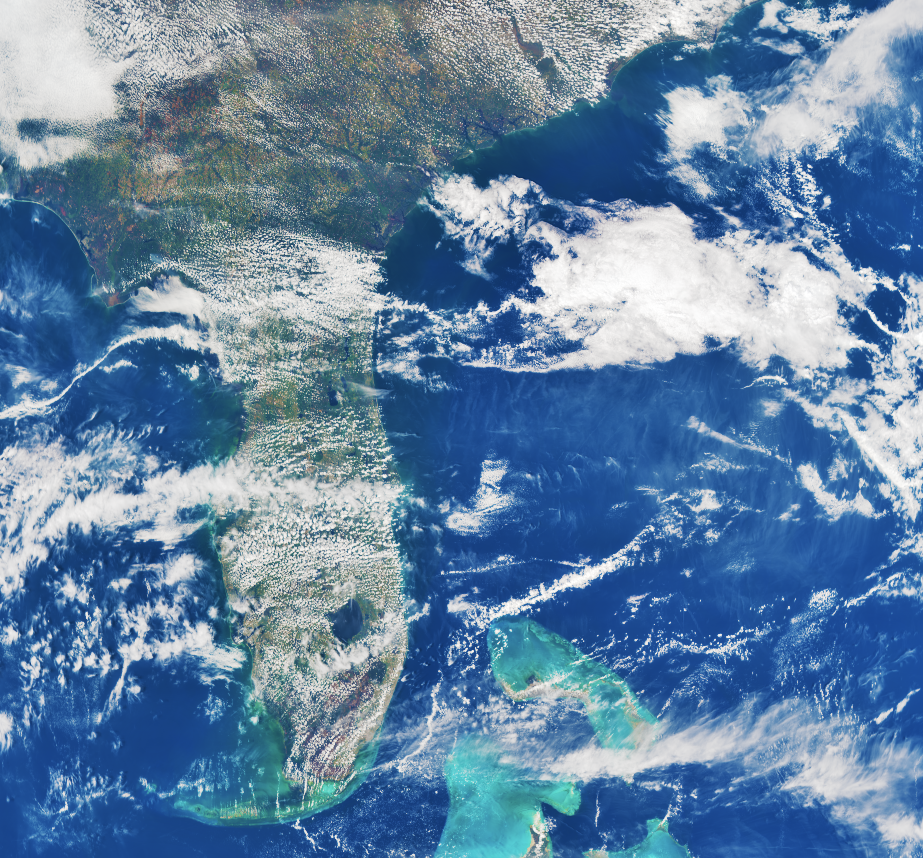
When we think of space exploration, we tend to imagine rovers hunting for long-gone seas on Mars or probes scouring for traces of life spewed from beneath the icy shell of a distant Saturnian moon. But we often forget, from our Earthly perspective, that Earth itself is a planet and can be studied from space like any other. NASA satellites have long been an invaluable tool for scientists to study our planet on scales of space and time that conventional sample collection cannot. Satellites have greatly expanded our knowledge of everything from weather, to river flows, vegetation changes, pollution, wildfires, dust storms, and marine plankton. In my work, I focus on the last two, seeking to understand how dust storms feed life in the sea.
One of the dustiest regions of the world is the tropical North Atlantic, where desert dust from North Africa is carried by the wind for vast distances, reaching South America, the Caribbean, and the western North Atlantic. Should this dust enter the sea, it can provide critical nutrients such as phosphorus and iron that plankton need to grow and thrive, nutrients that would otherwise be difficult to obtain in the open ocean far from land (Hamilton et al., 2022, 2023; Jickells et al., 2005; Myriokefalitakis et al., 2016). Of particular interest is the impact on phytoplankton, those photosynthetic plankton that convert energy from the sun into biological form, much as plants do on land. Like plants on land, marine phytoplankton are at the base of the food chain, making nearly all life in the ocean dependent on them. Understanding the extent to which dust storms influence phytoplankton in turn tells us a lot about biogeochemical cycles, those cycles of chemical elements (carbon, iron, nitrogen, phosphorus, etc.) moving through the atmosphere, ocean, biosphere, and sediments. This reveals how the Earth system as a whole works and informs our knowledge of climate cycles.
Satellites allow us to both track dust storms as they cross the Atlantic and observe changes in phytoplankton that occur in their aftermath, often by looking at the amount of chlorophyll in the water. Conveniently, the same satellites can tell us about the dust and the phytoplankton. For my research, I used observations from NASA’s Aqua and Terra satellites, which each carry the Moderate Resolution Imaging Spectroradiometer (MODIS) instrument. This instrument measures reflected light, which can then be interpreted based on its wavelengths to infer if there is a high concentration of particles in the atmosphere, which includes airborne dust, and to determine the amount of chlorophyll in the ocean. As these satellites have been orbiting the Earth for over twenty years and are constantly taking measurements, they have observed numerous dust storms and the data can now be used to show long-term patterns and trends. A third NASA satellite, the Cloud-Aerosol Lidar and Infrared Pathfinder Satellite Observation (CALIPSO), provides us with lidar data that can reveal if airborne dust is close to the sea surface, implying there’s a chance it could deposit into the ocean.
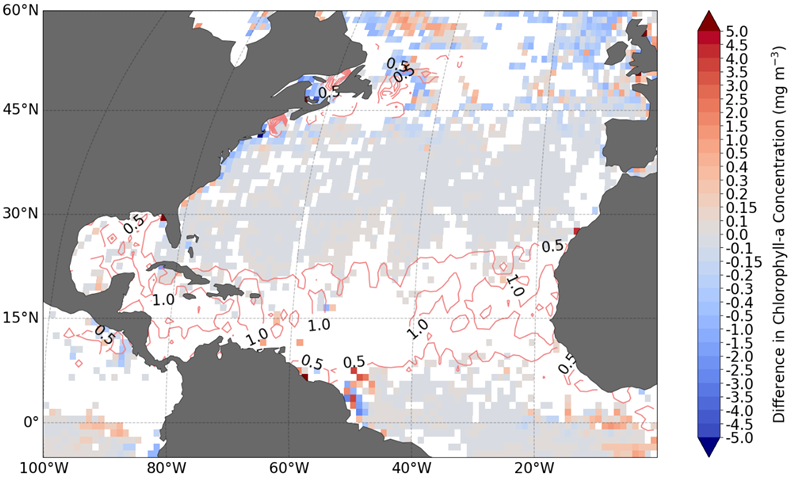
What Was Found
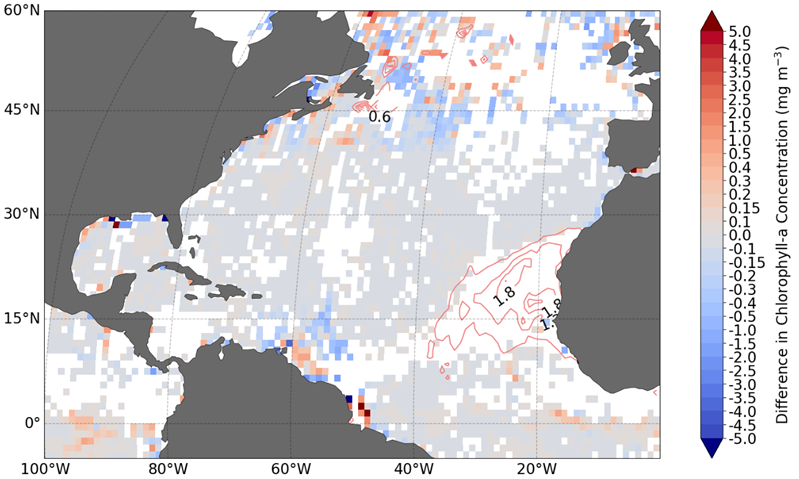
When reviewing our satellite data, we often found increases in chlorophyll, and other variables related to phytoplankton such as fluorescence, during or following a dust storm passing overhead. While this finding is encouraging, it comes with a few caveats. First, atmospheric dust can at times obscure the sea surface, making its impact on the ocean more challenging to evaluate. Second, some researchers have found that dust can interfere with the chlorophyll measurements themselves (Kramer et al., 2023). There are, however, additional tools we can use to maximize the utility of satellite data. Comparing changes to multi-decade trends, removing the influence of seasonal changes in chlorophyll, dust, and sea surface temperature, and applying machine learning models to better understand how different aspects of the ocean and atmosphere interact can reveal a clearer picture of this important part of the Earth system. Understanding the patterns and trends of the relationship between desert dust and phytoplankton can tell us a lot about how the Earth is changing. Additionally, this information can offer clues about the implications for the ecosystem and for the future, a valuable benefit of NASA’s satellites even if observing the impact of individual dust storms faces constraints.
My Journey Here
Combining air, sea, space, biology, and chemistry research has been complicated. While my undergraduate experience involved some science and math along the way, my major at Georgia Tech was in International Affairs. I studied and worked in health administration, where I first gained experience working with large datasets analyzing health insurance contracts for a hospital system. My experience in health administration paved the way for a Master’s program at UNC Chapel Hill’s public health school, originally focused on climate, health, and air quality. In the course of my studies, I found a class in biological oceanography cross-listed as a public health course. I loved the course and learned that the professor was collaborating with colleagues in public health on the impact of phytoplankton on aerosols, those atmospheric particles that have a major influence on biogeochemistry and air quality. From there my thesis was developed focusing on phytoplankton-driven aerosols near the Galápagos Islands.
I was able to work at the Goddard Space Flight Center as part of NASA’s DEVELOP program the summer before starting my PhD. During my Ph.D. at North Carolina State University, I chose to look at the impact of aerosols, such as desert dust, on marine life. This placed me on a project that heavily involved satellite data and gave me the opportunity to collaborate with several great scientists from around the country, including current and former NASA scientists. It also paved the way to a North Carolina Space Grant award as a Graduate Research Fellow.
My education and work have given me a more wholistic understanding of our world. Biogeochemistry and Earth system science are an important part of climate science, and anything that impacts phytoplankton, on which the entire marine food chain depends, eventually affects the marine ecosystem and the human economic activity that depends on it. Since climate science and economic activity at sea are matters of international concern, having some perspective on international relations leads to a more wholistic understanding of our world.
I have often thought about what it means that we so often use data from space to understand the Earth and to serve the needs of its inhabitants. Our development of space technology is often motivated by a desire to expand our horizons into the vast cosmos. But as has always been the case throughout NASA’s history, these wonderous technologies can find great use close to home. To thrive as a species and as a planet, we need to apply all the best tools at our disposal to improve and sustain our troubled world. When we look out at the stars, we often forget how amazing the Earth is in the context of the cosmos, with a 4.5-billion-year history of change and evolution that has created a home for life and civilization. How fitting that the same tools we developed to explore the universe should be used to preserve one of its most precious resources.
Citations
Hamilton, D. S., Baker, A. R., Iwamoto, Y., Gassó, S., Bergas-Masso, E., Deutch, S., Dinasquet, J., Kondo, Y., Llort, J., Myriokefalitakis, S., Perron, M. M. G., Wegmann, A., & Yoon, J.-E. (2023). An aerosol odyssey: Navigating nutrient flux changes to marine ecosystems. Elementa: Science of the Anthropocene, 11(1), 00037. https://doi.org/10.1525/elementa.2023.00037
Hamilton, D. S., Perron, M. M. G., Bond, T. C., Bowie, A. R., Buchholz, R. R., Guieu, C., Ito, A., Maenhaut, W., Myriokefalitakis, S., Olgun, N., Rathod, S. D., Schepanski, K., Tagliabue, A., Wagner, R., & Mahowald, N. M. (2022). Earth, wind, fire, and pollution: Aerosol nutrient sources and impacts on ocean biogeochemistry. Annual Review of Marine Science, 14, 303–330. https://doi.org/10.1146/annurev-marine-031921-013612
Jickells, T. D., An, Z. S., Andersen, K. K., Baker, A. R., Bergametti, G., Brooks, N., Cao, J. J., Boyd, P. W., Duce, R. A., Hunter, K. A., Kawahata, H., Kubilay, N., LaRoche, J., Liss, P. S., Mahowald, N., Prospero, J. M., Ridgwell, A. J., Tegen, I., & Torres, R. (2005). Global iron connections between desert dust, ocean biogeochemistry, and climate. Science, 308(5718), 67–71. https://doi.org/10.1126/science.1105959
Kramer, S. J., Bisson, K. M., & Mitchell, C. (2023). What data are needed to detect wildfire effects on coastal ecosystems? A case study during the Thomas Fire. Frontiers in Marine Science, 10. https://doi.org/10.3389/fmars.2023.1267681
Myriokefalitakis, S., Nenes, A., Baker, A. R., Mihalopoulos, N., & Kanakidou, M. (2016). Bioavailable atmospheric phosphorous supply to the global ocean: A 3-D global modeling study. Biogeosciences, 13(24), 6519–6543. https://doi.org/10.5194/bg-13-6519-2016
- Categories: