
Where Are They Now: Josh Reding
Where are They Now?
NC Space Grant Alumni Spotlight

“I pursued a career in science policy with the goal of using my technical background to make a tangible difference in the world. I am proud to stand up for the science I love and other critically important uses of the radio spectrum, including those with safety-of-life considerations.”
The night sky is getting crowded with constellations, but not all of them are stars.
Satellite constellations — large groups of satellites that fly in close proximity in carefully planned coordination — are rapidly changing the scope of astronomy. As more commercial systems fill Earth’s orbit, astronomers face growing challenges from radio interference and light pollution that can disrupt ground-based observations. Near-Earth space is getting bright and noisy.
UNC Chapel Hill alumnus Josh Reding is addressing these issues through a unique career at the intersection of astronomy, engineering and public policy: radio spectrum management.
“Radio spectrum management is a policy exercise grounded in physics, as systems using radio frequencies for wireless communication must coexist without causing harmful interference,” Reding said.
Today, Reding works in spectrum policy and engineering at The Aerospace Corporation, but his path into policy began with his own astronomy research as a physics graduate student. His research, “The Menagerie of “Failed” Type Ia Supernovae,” observed and characterized unusual white dwarf stars using the Southern Astrophysical Research (SOAR) telescope in Chile.
Three years into the project, his research group’s federal grant period ended. After hearing about North Carolina Space Grant from past recipients and advisors within his department, Reding applied for the Graduate Research Fellowship for 2020-2021.
“It offered an excellent opportunity to both receive recognition for my research and supplement my group’s funding mechanisms to ensure that my research would be completed,” said Reding. “Because of the NC Space Grant award, I was able to focus on my research and contribute more effectively to our new grant proposal for 2021, which was ultimately successful.”

“The NC Space Grant provides an excellent opportunity for students to independently craft research proposals and experience the grant application and award process on a more local scale. My award became the foundation for my contributions to my research group’s successful federal research proposal in 2021, and ultimately framed my understanding of the grants process which I would eventually manage from the reviewer side in much of my postdoctoral career.”
Following his Ph.D., Reding participated in the NC STEM Policy Post-Graduate Fellowship through NC Sea Grant and the Burroughs Wellcome Fund. He worked for one year in the NC Department of Commerce’s Office of Science, Technology & Innovation. “In that role I supported grant programs and initiatives aimed towards science- and technology-based economic development in North Carolina, including interfacing with NC legislators to explain the importance of STEM pursuits and the growth opportunities they create,” said Reding.
Reding brought his science policy experience to the federal level through the AAAS Science and Technology Policy Fellowship, where he worked in the U.S. National Science Foundation (NSF) Electromagnetic Spectrum Management unit.
Reding’s role with NSF was his first exposure to a career in radio spectrum management through both domestic and international policymaking, including in United Nations forums. Through this work, he also became involved in dark and quiet skies advocacy, particularly regarding radio spectrum access for astronomy, and continues to lead volunteer efforts in the field.
“I pursued a career in science policy with the goal of using my technical background to make a tangible difference in the world. My career path and exposure to radio spectrum management—a world which I did not know existed prior to joining NSF—has helped me become a leading voice and defender of astronomy in the new era of satellite constellations,” said Reding. “I am proud to stand up for the science I love and other critically important uses of the radio spectrum, including those with safety-of-life considerations.”
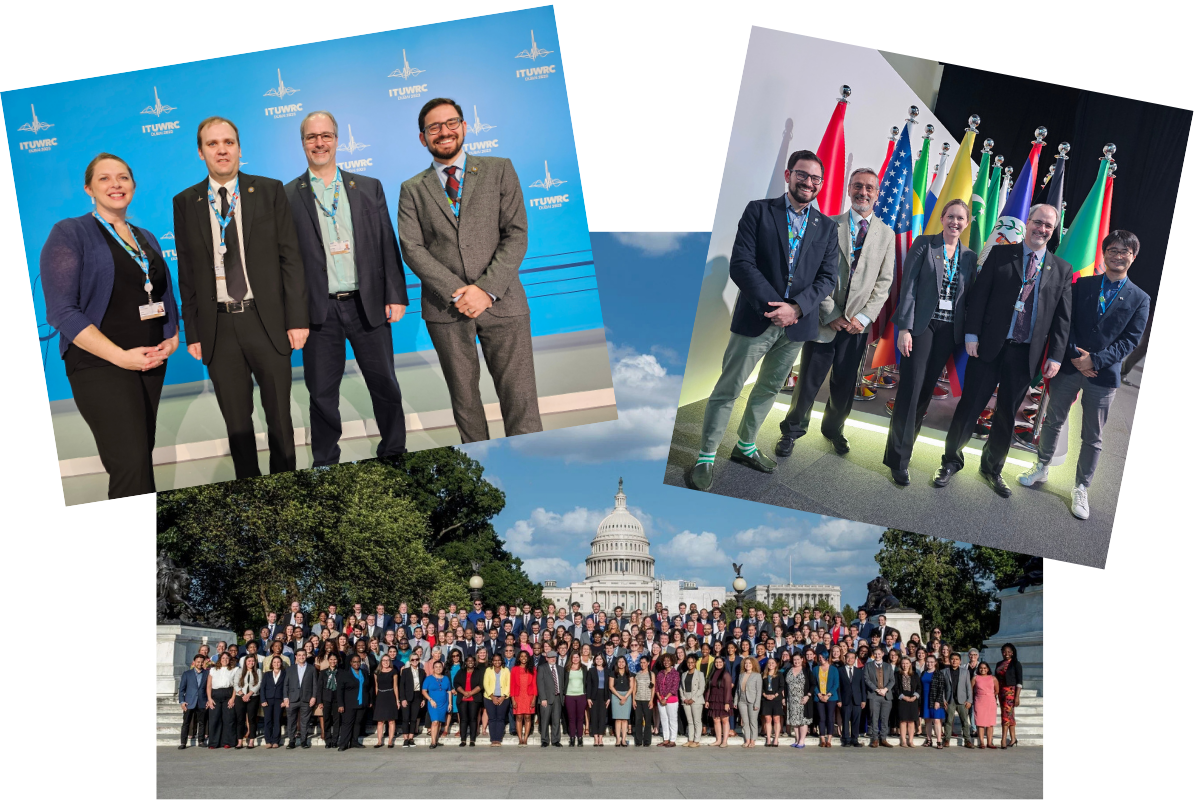
Bottom: The 51st class of AAAS Science & Technology Policy Fellows gather on the steps of the Capitol in Washington, D.C.
Reding’s Advice for Students
“When an opportunity presents itself, take it! You never know when meeting new people and demonstrating your skills to new audiences might pay off further down the line. Building and maintaining a wide professional network will open many doors. Consider a wide range of non-academic career opportunities. Ultimately, a PhD trains you to be a professional problem-solver, including fostering creativity, knowledge of statistics and inference, and comprehensive research strategies that can be applied in any field.”
Current Position: Spectrum Policy & Engineering – The Aerospace Corporation
Degrees: Double B.A. in Astronomy-Physics and Philosophy, Colgate University; M.S. and Ph.D. in Physics, UNC Chapel Hill
NC Space Grant Awards:
- NC Space Grant Graduate Fellow (2020-2021)
Favorite Space Projects: My favorite mission was the Kepler Space Telescope (rest in peace). It was an incredibly precise instrument for optical measurements and led to the discovery of thousands of planets and weird variable objects, including my discovery of the fastest-rotating white dwarf star known!
Quick links:
Find Josh on LinkedIn: https://www.linkedin.com/in/jsjreding/
Check out a recent talk Josh gave to the Maria Mitchell Association on the role of astronomy in space and satellite policy: https://www.youtube.com/watch?v=nsEVOyWv-Uw
- Categories:


