
Team Experience and Competition Grant Program
Deadline
October 9, 2026
5:00 PM ET
Open to
Faculty members qualified to serve as Principal Investigators (PIs) and student teams from accredited higher education institutions in North Carolina
Topic
STEM competitions related to NASA Directorates
Background
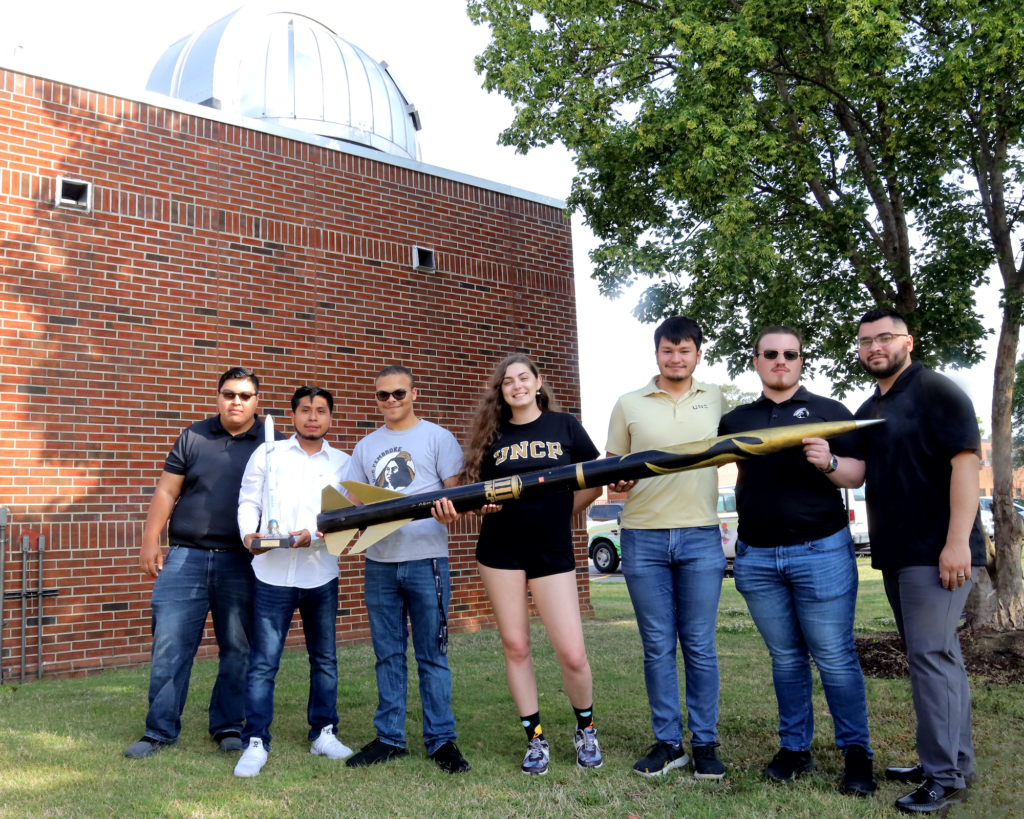
NC Space Grant (NCSG) awards funding to university teams of undergraduate and graduate students led by faculty Principal Investigators (PIs) to help them participate in national competitions either sponsored or sanctioned by NASA or another science, technology, engineering, and mathematics (STEM) related organization or industry. Examples of such competitions are the NASA Student Launch Initiative, NASA Human Exploration Rover Challenge (HERC), NASA Lunabotics, etc. Awards are contingent upon receipt of NASA funding and the quality of submitted proposals.
Objectives
Competitions should be in the fields of science, technology, engineering, and mathematics (STEM), and complement the academic studies of the team members. Competitions must provide students with hands-on experiential learning opportunities related to one or more of NASA’s Directorates.
NASA Directorates (realigned structure):
- Research and Technology
- Human Spaceflight
- Science
- Mission Support
Teams should be interdisciplinary in composition. Team members with different majors, departments, and/or skills such as fundraising and marketing, communications and social media, and education and outreach are encouraged to participate.
Award Details
NC Space Grant anticipates supporting up to 11 team competition grants for up to $5,000 per award. Awards are contingent upon receipt of NASA funding and the quality of submitted proposals.
- Budget Template: Proposers MUST use the budget template provided in Appendix A of the Request for Proposals (RFP). PIs will be asked to resubmit proposals not using the required format prior to review.
- Allowable Expenses: Funds can be used to purchase supplies and materials to support the team project, cover registration fees, and/or pay travel expenses for the competition.
- Unallowable Expenses: Funds cannot be used to fund equipment, direct student stipends/salaries, promotional items/apparel (e.g., t-shirts), or international travel. Purchases cannot be made from covered foreign entities (e.g., China, Iran, Russia) in accordance with NASA policy.
- Period of Performance (POP): Nov. 1, 2026 to July 15, 2027 (≈ 9 months). Funds should be fully expended within the POP for the competition year. Any competition dates extending beyond the POP (e.g., summer 2027) must be noted in the proposal.
- Application Limits: A team may apply for only one award. However, the same college or university may apply for multiple awards if funds are used for different challenges or competitions.
How to Apply
NC Space Grant invites faculty Principal Investigators (PIs) to propose collaborative teamwork experiences toward a challenge or competition, which must be named in the proposal and should take place within the POP of this award (i.e., no later than summer 2027). NC Space Grant should be notified of any impacts and changes in the proposed scope of work due to changes in the competition.
- Proposals must be submitted by the faculty advisor who will serve as the PI.
- Proposals must be submitted as a single PDF file to Sandy Canfield by email at [email protected] with “FY2026 Team Experience and Competition Proposal” in the email subject line.
- Submissions must be signed by the PI’s university Office of Sponsored Research (or equivalent). Projects selected for funding will receive a sub-award through the PI’s institution.
- Proposals should be single-spaced on standard 8 ½ x 11 paper, no smaller than 12-point font, and with no less than one-inch margins throughout. Text restrictions include all illustrations, tables, charts, exhibits, etc. All pages must be numbered sequentially.
- Deadline: Friday, October 9, 2026 (5:00 p.m. EST).
- Award Announcements: Week of October 26, 2026.
Proposal Guidelines
All proposals MUST include the following information in the order noted below. Proposals not meeting these requirements may not be considered.
1. Cover Page
Must include:
- Funding opportunity name (Team Experience and Competition)
- Project period of performance (November 1, 2026 – July 15, 2027)
- Competition date (if known)
- Total budget request (up to $5,000)
- PI’s name, institution, address, phone number, and email
- Signatures from the PI and an authorizing official at the proposing institution (Office of Sponsored Research or equivalent)
2. Project Content (Not to exceed 10 pages)
- Summary of the Team Competition: Official name of competition and sponsor, competition date(s), defined goal/objective, and an active link to the competition website. State if the competition is part of the NASA Artemis Student Challenges.
- Project Description: Detailed description of the project, how it meets competition goals, significant tasks, milestones, requirement check-ins, and competition dates.
- Description of Team Goals and Learning Objectives:
- Returning teams: Summary of past participation, lessons learned, and planned adjustments/modifications for this cycle.
- New teams: Description of why the competition was selected and what the team hopes to learn and accomplish.
- Alignment to a NASA Directorate: Describe alignment with one or more of NASA’s realigned directorates (Research and Technology, Human Spaceflight, Science, Mission Support).
- Summary of Team Composition and Member Recruitment: Narrative or table listing student team members, majors, skill sets, and roles/responsibilities. Non-STEM recruitment is strongly encouraged. If composition is unknown at submission, describe recruitment plans, target skills/roles, and timeline.
- Outreach Plan: Description of in-person outreach and/or online/remote engagement tools (e.g., YouTube channel, online demo/launch, shared open-source materials). Engagement with industry partners is strongly encouraged.
3. Additional Required Content (No page limit unless noted)
- Curriculum Vitae of the Faculty PI/Advisor (2 pages max).
- Letter of Support from Department Chair/Head confirming project importance and authorization to use university labs, assets, cost-share, etc.
- Budget and Budget Narrative:
- Must include a required 1:1 cost match. PIs must use the template provided in Appendix A.
- Travel details must be specific (e.g., 5 plane tickets at $300 each).
- Salaries/fringe rates used for cost-share must be justified.
- Facilities and Administrative (F&A) costs are not allowed by NC Space Grant; however, unrecovered F&A may be used toward the required cost-match.
- Cost-match should not exceed the $5,000 award limit, as all committed cost-match must be formally reported.
- Promotional items/apparel (e.g., t-shirts) are not allowed. Asset identification stickers are allowable.
- Purchases from restricted countries (e.g., China, Iran, Russia) are prohibited.
Eligibility
- Proposer must be a faculty member qualified to serve as a PI at an accredited higher education institution in North Carolina.
- Student team members must be enrolled in academic degree programs.
- Applicants must verify team eligibility against specific competition criteria (e.g., full-time status, U.S. citizenship requirements).
- The competition must occur during the 2026–2027 academic year (no later than summer 2027).
- Funding release is contingent upon competition acceptance and NASA funding availability.
Required Reporting
- Student Data Tables: Required by NASA. Due in November, February, and with the Final Report. Contact hours are required for all participants; demographic data is optional but strongly encouraged.
- NASA Gateway System Profile: Required for all students significantly engaged (≥160 contact hours).
- Longitudinal Tracking: Students with ≥160 contact hours will be tracked through the Education Programs Support Services (EPSS) system.
- Publications, Presentations, & Outreach: Awardees must submit generated outputs, public outreach event details, and check-ins via an NC Space Grant Google Form.
- Final Report: Due no later than August 15, 2027 (no more than 30 days after the end of POP). Must detail progress, milestones, competition results, student feedback quotes, and final student data updates. (Amendments may be submitted if competition dates fall after the POP).
- Program Surveys: Participation in evaluations administered by NC Space Grant, external evaluators, or NASA is required.
Awardee Expectations
- Safety First: Adhere strictly to state and institutional policies regarding classwork, lab work, travel, and safety.
- Public Engagement & Media: Collaboratively share progress on social media using consistent hashtags (e.g.,
#ncspacegrant) and visual documentation (photos/videos with proper waiver forms on file). - Sponsorship Credit: Credit NC Space Grant in all printed and digital materials/logos.
- 2027 NC Space Symposium: Teams are strongly encouraged to present and set up project models/demos at the NC Space Symposium on April 9, 2027, in Raleigh, NC. Grant funds may be budgeted for symposium travel.
Contact